


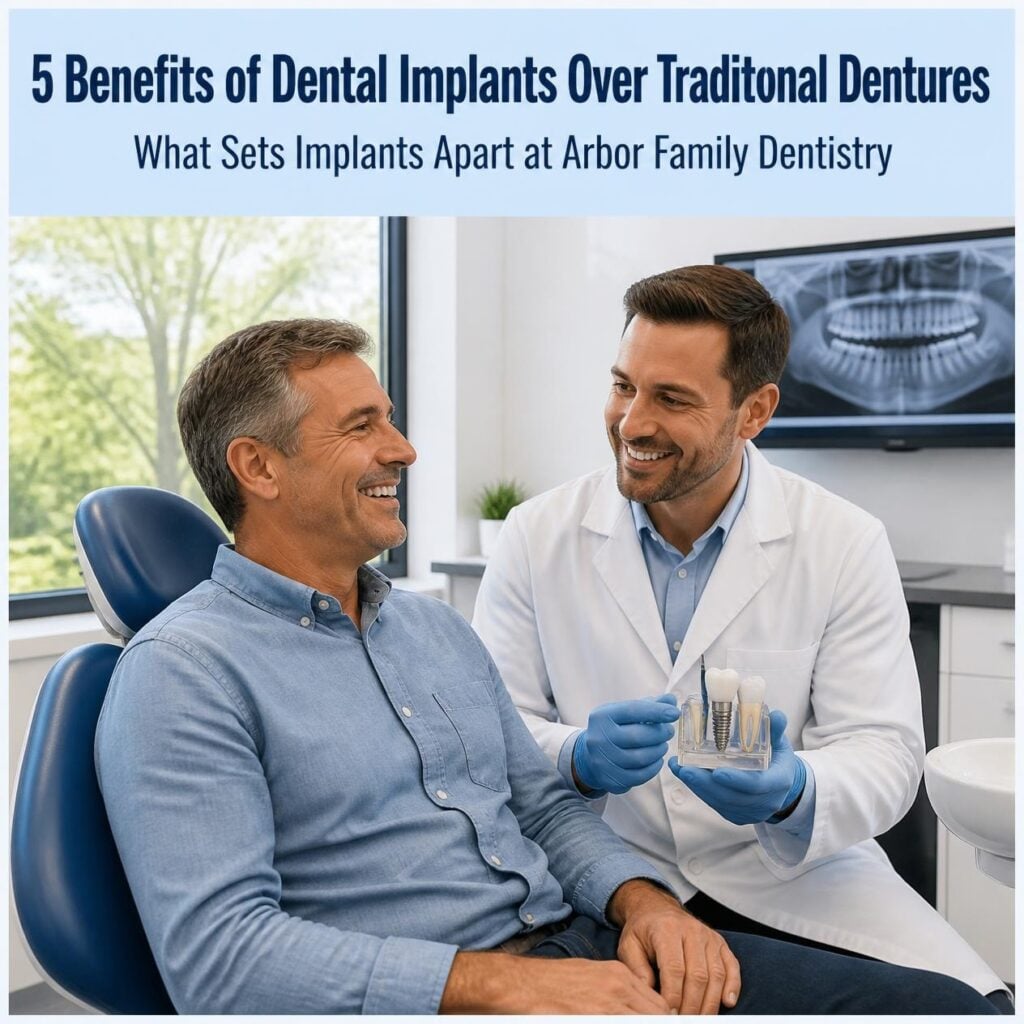
Dental implants beat traditional dentures on the five things patients care about most: chewing power, jawbone health, longevity, daily convenience, and a natural look and feel. Implants restore up to 90% of natural bite force and can last decades, while conventional dentures deliver only about 20–25% and usually need replacing every few years. Below are the five biggest benefits of dental implants over traditional dentures, an honest look at cost and candidacy, and how to decide which is right for you.
Dental Implants vs Dentures: The Quick Comparison
Both replace missing teeth, but they work in fundamentally different ways. A dental implant is a titanium post placed in the jawbone that acts like a natural tooth root. A traditional denture rests on top of the gums and relies on suction or adhesive to stay put.
That single difference, anchored in bone versus resting on gum, drives almost every advantage below.
| Factor | Dental Implants | Traditional Dentures |
| How they stay in | Fixed in the jawbone | Suction or adhesive paste |
| Chewing force restored | Up to ~90% of natural | ~20–25% of natural |
| Jawbone | Stimulates and preserves it | Doesn’t stop bone loss |
| Lifespan | Decades to a lifetime | Relined or replaced every 5–8 years |
| Daily care | Brush and floss like real teeth | Remove, soak, re-paste |
| Upfront cost | Higher | Lower |
The 5 Biggest Benefits of Dental Implants Over Dentures
1. You Chew at Nearly Full Strength Again
Natural teeth bite at roughly 150–250 psi. A full lower denture manages closer to 50 psi, and only when it stays put. Because an implant fuses into bone, it carries force the way a root did, restoring up to 90% of natural chewing power versus the 20–25% conventional dentures deliver.
In practice, that’s the line between planning meals around your teeth and biting into an apple, a bagel, or a steak without thinking. It protects nutrition too, since a weak bite pushes people toward soft, starchy food.
2. Your Jawbone and Face Keep Their Shape
Lose a tooth, and the bone that held it starts to melt away, up to 25% of its width in the first year and continuing for life. Dentures do nothing to stop it. They rest on the gum instead of replacing the root, and the pressure they put on the ridge can speed up the shrinkage.
That’s the hidden cycle behind loose dentures: the bone shrinks, the fit fails, the denture rocks, and the rocking wears the bone down further. Long-term wearers also develop a collapsed, prematurely aged lower face. An implant is the only replacement that works as a root, so the bone keeps the stimulation it needs to hold its shape.
3. You Buy the Solution Once, Not Every Few Years
Modern implants succeed in over 95% of healthy patients, and the titanium post can last the rest of your life. Only the visible crown may need swapping after 15 or more years of wear.
Dentures live on a replacement clock, relined or remade every five to eight years as the jaw shrinks beneath them. Add up two or three decades of relines, remakes, adhesive, and cleaning tablets, and the “cheaper” option quietly closes the gap. Implants cost more on day one and often less over a lifetime.
4. No Slipping, No Paste, No Off-Limits Foods
This is the benefit patients feel every single day. Fixed implants don’t come out, don’t need adhesive, and don’t shift when you laugh, sneeze, or bite corn off the cob. You clean them exactly like natural teeth, with none of the separate removable routine dentures demand.
- Implants: brush and floss in place, then eat what you want
- Dentures: remove after meals, soak overnight, re-paste daily
- The difference: implants stay put through a meal, a speech, or a belly laugh
5. They Look, Sound, and Taste Right
An implant crown is shaped and shaded to match the teeth beside it and rises from the gum like a real tooth, so it disappears into your smile. Most people can’t tell, and neither can you once it heals.
The upside goes past looks. A full upper denture covers the roof of your mouth with plastic, which muffles speech and blunts flavor. Upper implants skip that plate entirely, so you keep clear speech, your full sense of taste, and a smile you don’t have to constantly manage.
What About Cost and Candidacy? An Honest Look
Implants aren’t automatically the answer for everyone, and any dentist who tells you otherwise is skipping the fine print. Three honest considerations:
- Upfront cost is higher. Dentures win on day-one price. Implants win over the long run, but the initial investment is real.
- They involve minor surgery. Placement is a routine procedure under local anesthesia, but it does require healing time as the implant fuses with bone.
- You need enough bone. Years of denture wear or delayed treatment can shrink the jaw. When bone is thin, you may need a graft first, which a 3D scan can quickly reveal.
There’s also a middle path worth knowing about: implant-supported dentures (sometimes called snap-on dentures). They use just two to six implants per arch to lock a denture firmly in place, combining denture affordability with implant stability and bite force.
Read more: Do Dental Implants Hurt? What the Procedure Actually Feels Like
How Arbor Dental Helps
At Arbor Dental Family Dentist in Brentwood, Dr. Trieu Ton, a University of California, San Francisco School of Dentistry graduate, starts with a precise diagnosis, not a sales pitch.
We use cone beam 3D imaging to measure your exact bone volume and plan dental implant treatment down to the millimeter, so there’s no guesswork about whether you’re a candidate. When implants are the right call, we place them; when a snap-in denture is the smarter fit, we’ll tell you.
Nervous about the chair? Sedation dentistry options keep you relaxed from start to finish, and we reserve time for patients who want to move quickly once they’ve decided.
The Bottom Line
For most people replacing missing teeth, dental implants are the better long-term choice: they chew like natural teeth, protect the jawbone dentures leave to shrink, last for decades, and free you from adhesives and diet rules. Dentures remain a valid, budget-friendly option, but they replace teeth, while implants replace teeth and roots.
The right answer depends on your bone, your health, and your goals, and the only way to know is a quick exam and scan.
Your natural tooth is always best, and catching problems early can save it before it ever needs replacing.
Read more: 5 Signs You Need a Root Canal
We provide dental implants and implant-supported dentures to families across Knightsen, Antioch, Oakley, Byron, Bethel Island, and Discovery Bay.
Arbor Dental serves Brentwood, CA and the surrounding East Contra Costa County communities. You’ll find us at 6471 Lone Tree Way, Suite 301, Brentwood, CA 94513.
Book your consultation online, or call us directly at (925) 453-2333 to schedule.
Frequently Asked Questions
Are dental implants better than dentures?
For most patients, yes. Implants restore far more chewing power, preserve the jawbone, and last decades without slipping. Dentures cost less upfront and avoid surgery, which suits some patients. The best choice depends on your bone health, budget, and goals. A scan settles it quickly.
Can you replace all your teeth with implants?
Yes. A full arch doesn’t need one implant per tooth. Techniques like implant-supported dentures use just two to six implants per jaw to anchor a full set of teeth securely, giving you fixed or snap-in stability without the cost of replacing every single tooth individually.
How long do dental implants last compared to dentures?
The implant post can last a lifetime, with success rates above 95% in healthy patients; the crown may need replacing after 15-plus years. Traditional dentures typically need relining or replacement every five to eight years as the jawbone changes shape, so implants often cost less over time.
Are dental implants worth the extra cost?
For long-term value, usually yes. You pay more upfront, but you avoid the repeat relines and replacement dentures require, and you gain better chewing, bone preservation, and comfort. For patients on a tight budget or who want to avoid surgery, dentures remain a reasonable option.
Does getting dental implants hurt?
No. Implant placement is done under local anesthesia, so you feel pressure and movement, not pain. Most patients compare it to a routine filling. Mild soreness for a few days afterward responds well to over-the-counter pain relief and typically resolves within three to five days.
Can I still get implants if I’ve worn dentures for years?
Often, yes. Long-term denture wear can shrink the jawbone, but modern bone grafting can rebuild enough support for implants in many cases. A cone beam 3D scan shows exactly how much bone you have and whether a graft is needed before placement.
