


If fear of pain is what’s keeping you from booking that consultation, you’re not alone. It’s the single most common reason people put off getting dental implants, sometimes for years. So let’s address it honestly, without sugarcoating and without exaggerating.
The short answer: most patients are surprised by how little they feel during the procedure, and the discomfort in the days after is manageable for the vast majority.
In this post, we’ll walk through exactly what happens during surgery, what recovery actually feels like day by day, and how implants compare to other dental procedures you may have already been through. By the end, you’ll have a clear picture of what to expect, and you can decide whether fear is really standing between you and a solution that could last the rest of your life.
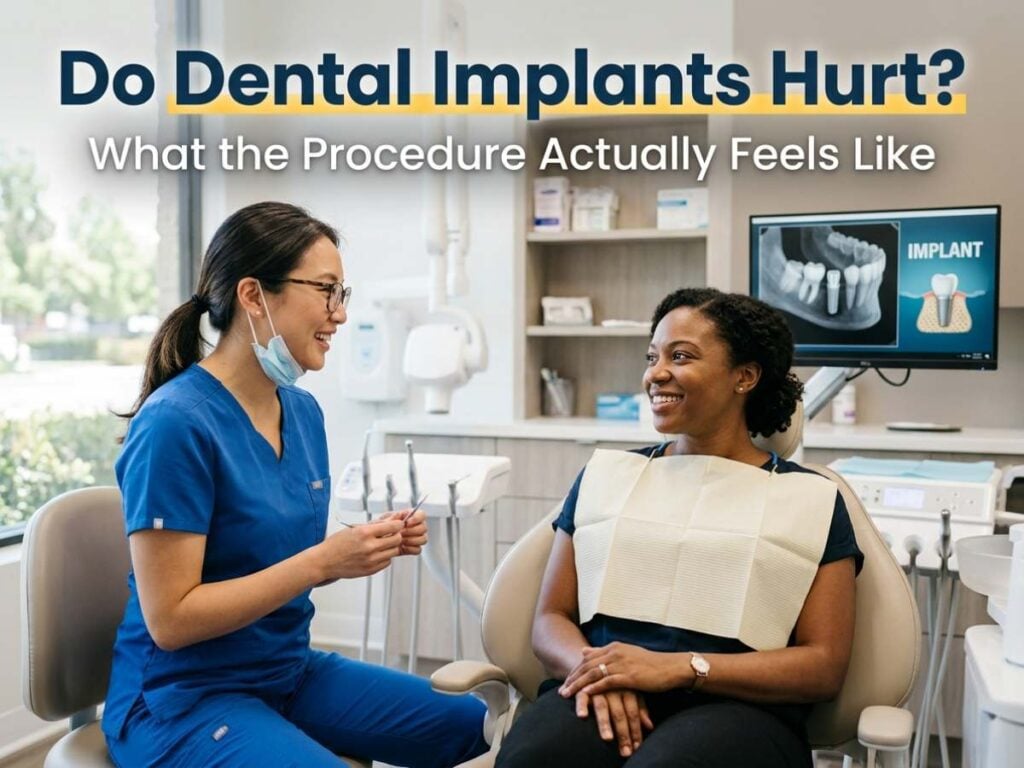
What You Actually Feel During Dental Implant Surgery
The most important thing to understand is that the procedure itself is performed under local anesthesia. Before your dentist makes a single incision, the entire area is completely numb. You will not feel pain during the surgery.
What you will feel is pressure and movement. As the implant post is placed into the jawbone, there’s a sensation of drilling and vibration, but nothing sharp. Many patients describe it as similar to getting a filling, just with a bit more going on. The implant site also has fewer nerve endings than the area around a tooth root, which is part of why it tends to be less sensitive than people expect.
On a pain scale of 1 to 10, most patients rate the surgery itself at 1 to 2, roughly comparable to getting a routine dental filling.
For patients with significant dental anxiety, sedation options are available. Oral sedation (a pill taken before the appointment) keeps you relaxed and drowsy throughout the appointment. IV sedation provides a deeper level of calm and is commonly used for more complex cases or highly anxious patients. Either way, your dentist should walk you through the options before your appointment.
What If I Feel Pain During Surgery?
If at any point you feel something sharper than pressure, raise your hand. Your dentist will pause, add more anesthetic, and then continue. This is completely normal and nothing to feel embarrassed about. You are always in control of what happens in the chair.
How Much Pain Is Normal After Dental Implant Surgery?
Once the anesthesia wears off, a few hours after the procedure, some soreness is expected. This is your body starting its healing process, and it’s completely normal. What it should NOT feel like is severe or worsening pain.
Implant recovery pain typically peaks at 24 to 48 hours after surgery and resolves significantly by day 3 to 5. Most patients describe it as a dull ache, jaw stiffness, or tenderness around the implant site, not sharp or stabbing.
Standard pain management includes over-the-counter ibuprofen or acetaminophen, and your dentist may prescribe something stronger for the first day or two if needed. Ice packs applied in 20-minute intervals during the first 24 hours help significantly with swelling.
When to call your dentist: If pain increases after day 5 instead of improving, or if you develop a fever, worsening swelling, or an unpleasant taste at the site, contact your dentist. These can be signs of infection or other complications that need to be caught early.
Day-by-Day Recovery Timeline
| Day | What to Expect |
| Day 1 | Numbness wears off; mild to moderate soreness begins; rest recommended |
| Day 2-3 | Peak swelling and discomfort; manageable with OTC medication |
| Day 4-5 | Noticeable improvement; soft foods still advised |
| Day 7-10 | Most patients feel near-normal; stitches may be removed |
| Weeks 2-4 | Osseointegration begins silently; little to no discomfort |
Is Implant Surgery More Painful Than a Tooth Extraction?
This comparison surprises most people. Many patients who have had a tooth pulled report that their implant surgery was actually less uncomfortable than the extraction. Here’s why that makes sense.
Tooth extractions involve removing a root from the bone and often tearing the surrounding gum tissue. There’s usually more post-operative trauma to the area. Implant surgery, by contrast, is a controlled, precise procedure. A small hole is drilled, and the titanium post is placed, with minimal disruption to surrounding tissue when done correctly.
- vs. tooth extraction: extractions tend to involve more tissue trauma and comparable or greater recovery discomfort
- vs. root canal: most patients find implants more comfortable, with less anxiety-inducing sensation during the procedure
- vs. wisdom tooth removal: wisdom tooth recovery is typically more intense, with more swelling and a longer healing window
If you have survived a tooth extraction, you can handle a dental implant. The procedures are genuinely comparable, and many patients find the implant easier.
What Affects How Much Discomfort You Feel?
Pain is not one-size-fits-all, and several factors influence your individual experience.
- Number of implants: a single implant involves less recovery than multiple placements in the same session
- Bone grafting: If your jaw requires a graft before the implant can be placed, expect additional soreness and a longer healing timeline
- Personal pain threshold: everyone is different, and that’s completely valid
- Aftercare compliance: Following your dentist’s post-op instructions closely makes a measurable difference in how you feel
- Technique and experience: a skilled dentist using minimally invasive approaches reduces tissue trauma and speeds healing
How to Make Your Implant Recovery Easier
The good news: most of what determines your recovery experience is within your control.
- Take your pain medication before the anesthesia fully wears off. Don’t wait until you’re already uncomfortable. Getting ahead of the pain is much easier than chasing it.
- Apply ice packs for 20 minutes on, 20 minutes off during the first 24 hours to reduce swelling.
- Eat soft foods for the first few days: yogurt, mashed potatoes, scrambled eggs, smoothies. Avoid anything crunchy or chewy near the implant site.
- Do not smoke. Smoking significantly increases pain levels, delays healing, and raises the risk of implant failure. This is not a minor point.
- Sleep with your head slightly elevated for the first couple of nights. It helps reduce overnight swelling.
- Don’t skip your follow-up appointment. Your dentist needs to confirm healing is on track and catch any issues early.
“I’m Still Scared” – That’s Completely Normal
Dental anxiety is not a weakness. It’s one of the most common fears people carry, and it often stems from a previous negative experience or simply from not knowing what to expect. Both are completely understandable.
What helps most is information and communication. The more you understand what will happen and when, the less your imagination runs away with it. Before any procedure, ask your dentist to walk you through each step. Ask about sedation. Ask what signals you can use to pause the procedure if needed. A good dental team welcomes these conversations.
We’ve had patients who sat in our waiting room for 20 minutes, working up the nerve to come in. After their surgery, almost every one of them said the same thing: “I wish I had done this sooner.” That’s not a sales line. It’s genuinely what happens when the fear turns out to be bigger than the reality.
Ready to Stop Letting Fear Make the Decision?
Here’s what we want you to take away from this: the fear of implant pain is almost always significantly worse than the experience itself. Most patients come in braced for something difficult and leave wondering what they were so worried about.
Yes, there’s a recovery period. Yes, you’ll have some soreness. But we’re talking about a few days of manageable discomfort in exchange for a permanent solution that looks, feels, and functions like a natural tooth for decades. That’s a trade most people are more than happy to make once they clearly understand it.
If you’re ready to talk through your specific situation, including your anxiety level and which sedation options might be right for you, we’d love to have that conversation. Book a consultation and come in with all your questions.
Frequently Asked Questions About Dental Implant Pain
1. Do dental implants hurt during surgery?
No. Local anesthesia ensures the area is completely numb before any work begins. You feel pressure and movement, not pain. If you ever feel discomfort during the procedure, you can signal your dentist, and more anesthetic will be added.
2. How bad is the pain after dental implants?
Most patients describe post-surgical discomfort as mild to moderate, peaking around 24 to 48 hours after surgery and resolving within 3 to 5 days with standard over-the-counter pain relief.
3. What does implant surgery feel like?
Pressure, vibration, and movement. With proper anesthesia, there should be no sharp pain during the procedure. Most patients are genuinely surprised by how manageable it is.
4. Is dental implant recovery painful?
It involves some soreness and swelling for a few days, but most patients find it manageable and report it to be less intense than a tooth extraction. Following your aftercare instructions makes a significant difference.
5. How long does dental implant pain last?
Acute discomfort typically lasts 3 to 5 days. Some mild tenderness at the site may persist for up to 2 weeks as the area heals, but it should not interfere with daily life.
