


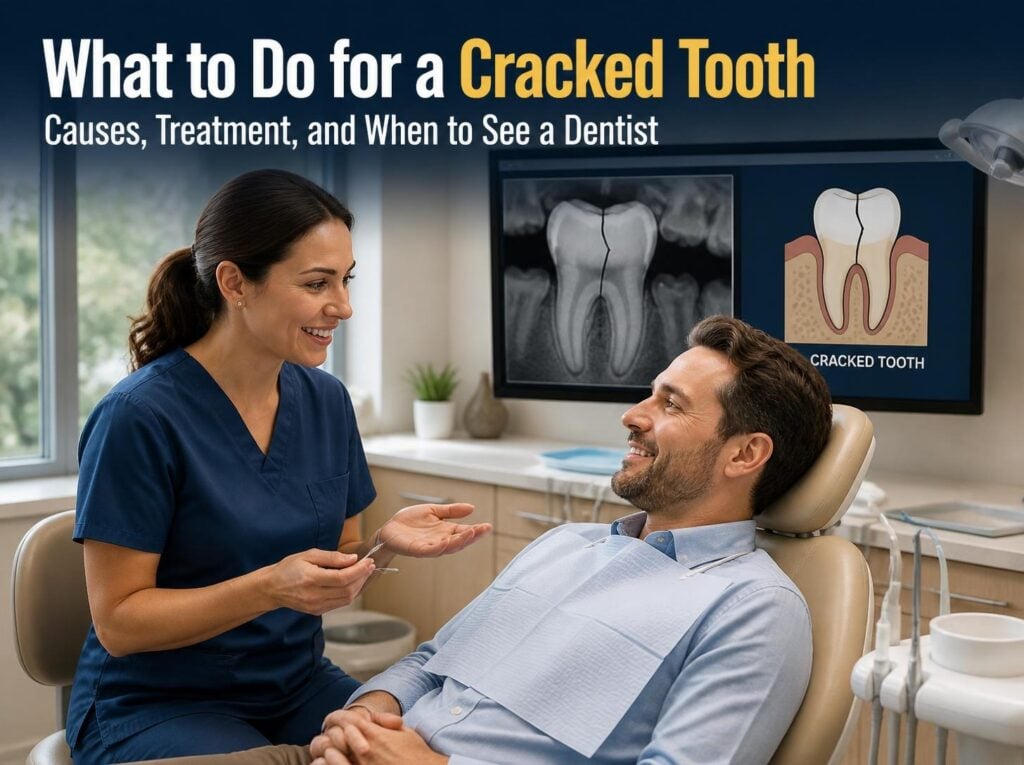
If you have a cracked tooth, rinse with warm water, apply a cold compress to reduce swelling, and call your dentist right away to protect the tooth from further damage. Knowing what to do in the first few hours can mean the difference between a simple repair and losing the tooth entirely. This guide covers the causes, treatment options, and when to see a dentist.
A crack is not always an emergency, but it is never something to ignore. Even a small fracture can let bacteria reach the tooth’s sensitive inner layers, and the problem rarely heals on its own.
What to Do for a Cracked Tooth Right Away
The steps you take in the first hour shape your outcome. Here is exactly what to do for a cracked tooth before you reach the office.
- Rinse your mouth with warm water to clean the area and remove any debris.
- Control bleeding by applying gentle pressure with clean gauze for about 10 minutes.
- Reduce swelling with a cold compress against your cheek, not directly on the tooth.
- Manage pain with an over-the-counter anti-inflammatory such as ibuprofen if you can take it safely.
- Protect the tooth by avoiding chewing on that side and skipping very hot, cold, or hard foods.
If a piece of the tooth broke off, keep it in a small container with milk or saliva and bring it to your dentist. Your dentist may be able to use it to repair the tooth.
Tooth Cracked: What to Do When You Feel Pain
When a crack starts to hurt, you need to act fast. Pain usually means the fracture has reached a nerve or the inner pulp, so you shouldn’t ignore it.
Rinse gently, take an over-the-counter pain reliever, and avoid chewing on that side. Dabbing clove oil on the area can temporarily calm discomfort, but it is only a stopgap until your dentist can examine the tooth.
What Causes a Cracked Tooth?
Teeth are strong, but they are not indestructible. Most cracks build up over time rather than happening all at once. Common causes include biting down on hard foods like ice, popcorn kernels, or hard candy, and sudden trauma from a fall or sports injury.
Other frequent culprits include chronic teeth grinding, large old fillings that weaken the surrounding enamel, and natural wear from age. Rapid temperature changes, such as eating something hot right after something cold, can also stress the enamel until it fractures.
Sometimes the structure was already compromised. A tooth with a large filling or past decay has less healthy enamel holding it together, making it much more likely to split under normal pressure.
Tooth Is Chipping: What It Means and What to Do
If your tooth is chipping in small pieces, it often signals weakening enamel. Chips can come from grinding, acid erosion, or a failing old restoration.
A chip may seem minor, but it leaves a rough edge that can cut your tongue and expose the tooth to decay. Save any fragment, avoid chewing on that side, and have the chip evaluated so it does not turn into a deeper crack.
How to Fix a Cracked Tooth: Your Treatment Options
There is no single answer for fixing a cracked tooth because the right repair depends on how deep the crack runs and where it sits. After an exam and often an X-ray, your dentist will match the treatment to the damage.
- Dental bonding or filling: For small chips and shallow cracks, a tooth-colored filling or dental bonding restores the shape quickly.
- Dental crown: A deeper crack usually needs a dental crown, a cap that covers and protects the entire tooth.
- Root canal therapy: When the crack reaches the pulp, root canal therapy removes the damaged inner tissue and saves the tooth.
- Extraction: If the crack extends below the gum line and splits the root, you may need to remove the tooth, often followed by an implant or bridge.
The earlier you act, the more likely you are to stay in the simpler, less costly end of this list.
Treatment for Cracked Tooth Types You Should Know
Correct treatment for cracked teeth starts with identifying the type, because not all cracks are equal. Dentists generally sort them into five categories.
- Craze lines: Tiny surface cracks in the enamel that are harmless and usually need no treatment.
- Fractured cusp: A piece near a filling breaks away, often repaired with a crown.
- Cracked tooth: A crack that runs toward the root and needs prompt care to prevent it from spreading.
- Split tooth: The tooth separates into segments and often cannot be fully saved.
- Vertical root fracture: A crack that starts at the root and often leads to extraction.
Because a crack can worsen between when you notice it and when you see a professional, only a professional evaluation can reliably tell you what you are dealing with.
When to See a Dentist for a Cracked Tooth
Call your dentist as soon as you suspect a crack, even if there is no pain. Some fractures are invisible to you but still progressing underneath. Certain warning signs mean you should seek urgent care rather than waiting.
- Sharp pain when biting or releasing a bite
- Pain or sensitivity to hot, cold, or sweet foods
- Swelling around the gum near the tooth
- Bleeding that does not stop or a visible large break
Severe pain, swelling, or a tooth knocked loose counts as a true emergency. If that happens, contact an emergency dentist immediately.
How Arbor Dental Treats Cracked Teeth
At Arbor Dental, Dr. Trieu Ton and the team start every cracked-tooth visit the same way: a gentle exam and digital imaging to find exactly where the crack runs and how deep it goes. Catching it early lets us use conservative repairs and save as much of your natural tooth as possible.
From there, we walk you through your options in plain language: bonding, a crown, or specialized cracked-tooth care, so you understand what each one involves before anything happens. Because we handle every repair under one roof, you are never bounced between offices during a stressful week. For anxious patients, the comfort-focused approach makes getting help far less intimidating.
Final Thought
A cracked tooth rarely gets better on its own, but it’s manageable when you act early. Rinse, protect the area, ease any pain, and get it checked before a small crack becomes a root canal or an extraction. The sooner you see it, the simpler and less expensive the fix usually is.
If you have a cracked or chipped tooth and want a clear answer about what it needs, we are ready to take a look and talk it through with you.
Arbor Family Dentistry serves Brentwood, CA, and the surrounding East Contra Costa County communities, including Antioch, Oakley, Byron, Bethel Island, Knightsen, and Discovery Bay. You’ll find us at 6471 Lone Tree Way, Suite 301, Brentwood, CA 94513.
Book your appointment online, or call us directly at (925) 453-2333 to schedule.
Frequently Asked Questions
Can a Cracked Tooth Heal on Its Own?
No. Unlike bone, tooth enamel cannot regenerate or repair itself once it cracks. The fracture will remain or worsen over time, so you need professional treatment to seal and protect the tooth before bacteria reach the inner pulp.
Is a Cracked Tooth a Dental Emergency?
It depends on severity. Minor craze lines are not urgent, but a crack with severe pain, swelling, bleeding, or a loose tooth is an emergency. When in doubt, call your dentist; cracks can worsen quickly, and early care yields the best outcome.
How Much Does It Cost to Fix a Cracked Tooth?
Cost varies by treatment. Bonding or a filling is the most affordable option, while crowns and root canals cost more. Many dental insurance plans help cover repairs. Arbor Dental also offers financing so cost does not delay the care you need.
What Happens if You Leave a Cracked Tooth Untreated?
An untreated crack usually spreads. It can lead to infection, abscess, intense pain, and eventually tooth loss. What might have been a quick filling can turn into a root canal or extraction, so prompt treatment is almost always the simpler and cheaper path.
Can You Eat With a Cracked Tooth?
You can, but carefully. Chew on the opposite side and avoid hard, sticky, very hot, or very cold foods that can deepen the crack or trigger pain. This is a short-term measure only, not a substitute for seeing a dentist as soon as possible.
