


Are dental implants better than dentures? Yes, for most patients, dental implants are superior due to their durability (lasting 15-25+ years), bone preservation capabilities, and restoration of 80-90% natural bite force. However, dentures remain the better choice for those needing immediate tooth replacement, having insufficient bone density, or requiring a more affordable solution ($600-$8,000 vs $1,500-$6,000 per tooth).
The “best” option depends on your bone health, budget, and lifestyle priorities. Both can restore your smile and eating ability, but they differ significantly in longevity, functionality, and daily impact. This comprehensive guide examines the evidence to help you make an informed choice.
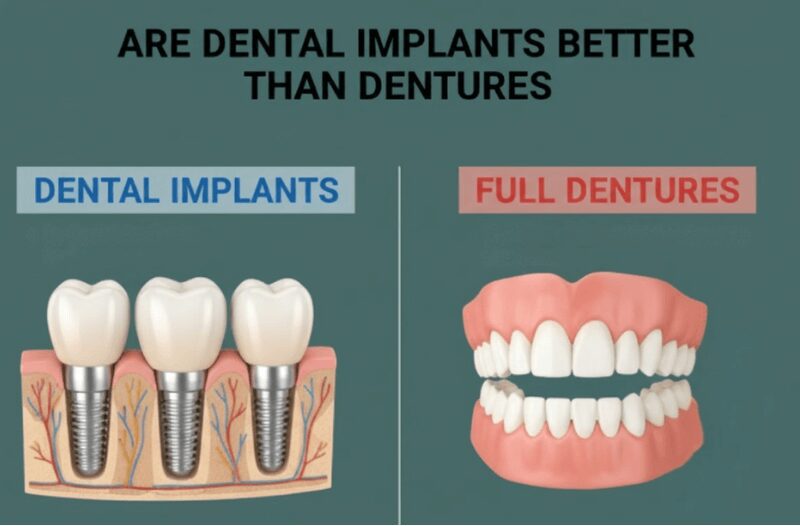
Quick Comparison: Dental Implants vs Dentures
| Factor | Dental Implants | Dentures |
| Durability | 15-25+ years (often lifetime) | 5-10 years (require replacement) |
| Cost (Initial) | $1,500-$6,000 per tooth | $600-$8,000 per arch |
| Cost (Long-term) | Lower (minimal maintenance) | Higher (replacements, adjustments) |
| Bone Preservation | Prevents bone loss | Bone loss continues |
| Stability | Fixed, won’t slip | Can slip or move |
| Eating Ability | Bite force near natural teeth | 25% of natural bite force |
| Maintenance | Brush and floss like natural teeth | Daily removal and cleaning |
| Treatment Time | 3-6 months | 2-8 weeks |
| Candidacy | Requires adequate bone, good health | Almost anyone |
What Are Dental Implants and How Do They Work?
Dental implants are permanent tooth replacements that function like natural teeth from root to crown. Unlike dentures that sit on your gums, implants integrate directly with your jawbone to create a stable, long-lasting foundation.
The three-component system includes:
- Titanium post: Surgically placed into your jawbone to serve as an artificial tooth root
- Abutment connector: A small piece that connects the post to the crown
- Custom crown: A tooth-colored dental restoration designed to match your natural teeth
The surgical placement process involves inserting the titanium post directly into the jawbone, where it fuses through a biological process called osseointegration over 3-6 months. This integration creates remarkable stability that mimics your natural tooth root, allowing the implant to function independently without affecting neighboring teeth. Once healed, your dentist attaches a custom-designed crown that matches your surrounding teeth in color, shape, and size.
Understanding Dentures: Traditional Tooth Replacement
Dentures are removable prosthetic devices designed to replace missing teeth and surrounding tissues. They’ve been the standard tooth replacement option for centuries, evolving significantly in materials and comfort.
Key characteristics of dentures:
- Full dentures: Replace an entire arch of teeth (upper or lower)
- Partial dentures: Fill gaps when some natural teeth remain
- Removable Dentures: Taken out daily for cleaning and overnight
- Gum-supported: Rest on your gums rather than integrating with bone
These appliances are custom-made from impressions of your mouth and fit over your gums, held in place by natural suction, adhesive creams, or clasps that attach to existing teeth. Modern dentures have improved significantly in appearance and comfort, but they still rest on your gums rather than integrating with your jawbone, which creates fundamental differences in stability and function.
Durability Showdown: Which Lasts Longer?
When comparing implants versus dentures for longevity, the numbers tell a compelling story. Dental implants clearly outperform with success rates exceeding 95% over 10 years, and many last 25 years or a lifetime with proper care.
Dental implant lifespan factors:
- Titanium post rarely needs replacement
- The crown may require renewal after 10-15 years due to normal wear
- Success rate of 95-98% when properly maintained
- Lifetime solution for most patients
Denture replacement timeline:
- Typical lifespan of 5-10 years before replacement is needed
- Bone resorption requires frequent adjustments and relining
- Material wear and deterioration over time
- Multiple replacements needed over 20-30 years
While dentures require regular adjustments every 6-12 months and complete replacement every 5-10 years, implants remain stable once integrated, making them the more durable long-term investment for tooth replacement.
Cost Analysis: Initial Investment vs Lifetime Value
The upfront cost for dental implants ranges from $1,500 to $6,000 per tooth, making them significantly more expensive initially than dentures, which cost $600-$8,000 per full arch. However, analyzing the 20-year cost reveals a different financial picture.
Denture ongoing costs include:
- Replacement every 5-10 years: $2,400-$32,000 total
- Adhesives: $150-$300 annually ($3,000-$6,000 over 20 years)
- Adjustments and relining: $200-$500 every 1-2 years
- Repairs for cracks or breaks: $100-$300 per incident
Dental implant long-term costs:
- Minimal ongoing expenses beyond regular dental hygiene
- Possible crown replacement after 10-15 years: $1,000-$3,000
- Standard dental cleanings and checkups
- No adhesives or special cleaning products needed
Insurance coverage varies widely. Traditional plans often cover 50% of denture costs but may provide limited implant coverage, though some newer plans recognize implants as medically necessary. Dental savings plans, health savings accounts (HSAs), and financing options can make either choice more accessible to patients.
Functionality: Eating, Speaking, and Daily Comfort
Are dental implants better than dentures for everyday function? The answer lies in biomechanics and how each option interacts with your mouth.
Chewing efficiency and bite force:
- Dental implants restore 80-90% of your natural bite force
- Dentures provide only 25% of the natural chewing power
- Implant wearers can eat crunchy vegetables, tough meats, and sticky foods
- Denture wearers must avoid hard, chewy, or sticky foods
Speech clarity differs notably between the two options. Implants feel and function like natural teeth, causing no speech impediments or adjustments needed. Dentures can slip or click during conversation, affecting the pronunciation of certain sounds until you adapt. Many denture wearers report difficulty with “s” and “f” sounds, especially when the prosthetic is new.
Comfort considerations:
- Implants eliminate the palate-covering plate required on upper dentures
- Full taste and temperature sensation are preserved with implants
- No gum soreness or irritation, common with denture pressure points
- Dentures may cause discomfort during the adjustment period
The difference in comfort and functionality significantly impacts quality of life, with implant recipients reporting 85% satisfaction compared to 65% for conventional denture wearers.
Critical Health Impact: Bone Preservation vs Bone Loss
The most significant health difference centers on bone preservation—an aspect many patients don’t consider until it’s too late. When you lose teeth, the jawbone begins deteriorating without root stimulation, a process called resorption.
How dental implants preserve bone:
- Act as artificial roots, stimulating jawbone tissue
- Prevent bone resorption through daily chewing forces
- Maintain facial structure and youthful appearance
- Support neighboring teeth and overall oral health
Denture-related bone loss:
- Cannot prevent bone resorption
- Pressure on the gums can accelerate bone loss by 25% in the first year
- Progressive bone loss requires frequent denture adjustments
- Eventually affects facial aesthetics, causing a “sunken” appearance
This progressive change leads to wrinkles around the mouth, collapsed facial features, and an aged appearance that advances over time. Beyond cosmetics, maintaining bone density supports overall oral health, preserves neighboring teeth, maintains proper bite alignment, and can even affect nutrition by allowing you to eat a wider variety of healthy foods.
The Verdict: Choosing the Right Solution for You
For most patients seeking the best long-term outcome, dental implants provide superior functionality, durability, bone preservation, and quality of life. They’re ideal when you have good bone density, prioritize permanent solutions, and can manage the initial investment. Dentures make more sense when cost is prohibitive, you need immediate tooth replacement, lack sufficient bone for implants, or have health conditions preventing surgery.
Consider the hybrid option: implant-supported dentures combine the stability of implants with the comprehensive coverage of dentures at a middle price point. This “all-on-4” or “all-on-6” approach uses 4-6 implants to anchor a full denture securely. Ultimately, your dentist can assess your bone structure, budget, health status, and goals to recommend the most appropriate path forward.
Conclusion
The decision between dental implants and dentures isn’t one-size-fits-all; it depends on your unique dental health, financial situation, and lifestyle priorities. While dental implants offer superior longevity, functionality, and bone preservation for most patients, dentures remain a viable, more immediate solution for specific circumstances.
The key is understanding what matters most to you: long-term value versus upfront cost, permanent stability versus removable convenience, and maximum functionality versus adequate restoration. Schedule a consultation with an experienced implant dentist or prosthodontist who can evaluate your candidacy, discuss all options, including hybrid approaches, and create a personalized treatment plan.
