


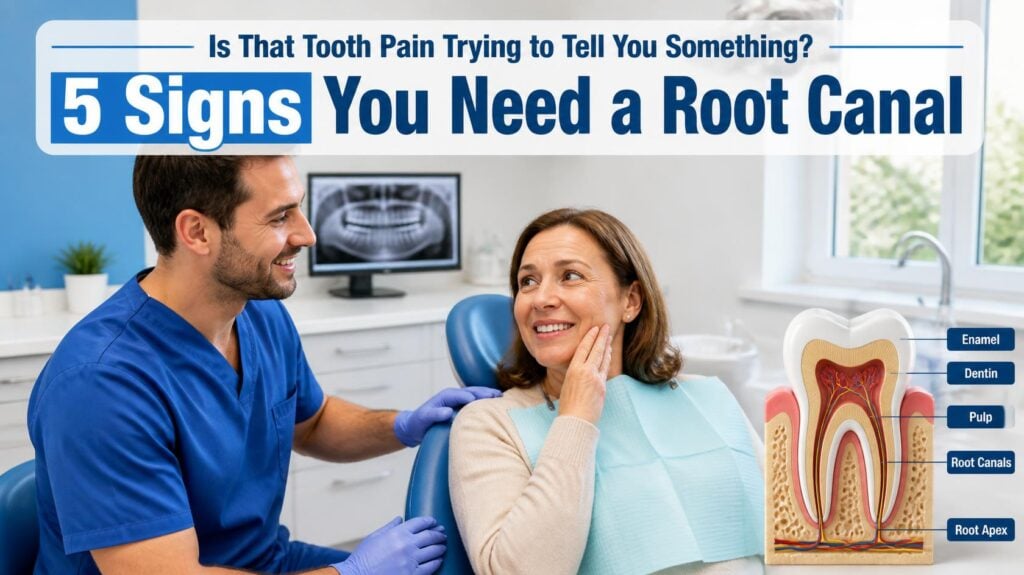
That tooth that flares up with hot coffee. The dull ache that keeps you up at night. The tender spot you keep chewing around. It’s easy to hope a sore tooth will settle on its own. Most of the time, it won’t.
Here’s the short answer: you would need a root canal when the pulp inside a tooth (the nerves and blood vessels) becomes infected or inflamed and can no longer heal on its own. If you’ve wondered why you would need a root canal instead of a simple filling, it comes down to how deep the damage reaches.
The reassuring part is that teeth usually warn you first. So would you know if you needed a root canal? Often, yes. This guide breaks down the five clearest signs you need a root canal, what a tooth abscess really means, and when tooth pain crosses the line into a dental emergency.
Why Would You Need a Root Canal?
Deep inside every tooth is soft tissue called pulp. When decay, a crack, trauma, or repeated dental work lets bacteria reach that pulp, it can’t heal itself the way a scraped knee does.
Once the pulp is infected, you have two realistic paths: remove the infected tissue with a root canal, or eventually lose the tooth. A root canal cleans out the infection, seals the canal, and a dental crown restores strength.
Here’s the part most people get backwards. According to the American Association of Endodontists, a modern root canal relieves tooth pain rather than causing it. The procedure feels similar to getting a filling. It’s the infection that hurts, not the treatment.
5 Signs You Need a Root Canal
Not every toothache means a root canal. But these five signals are the ones that most reliably point to pulp damage. If one sounds familiar, get it checked.
1. Pain That Lingers After Hot or Cold
A quick zing from ice water is normal. A dull ache that keeps throbbing for 30 seconds or more after the hot or cold is gone suggests the nerve is inflamed. Lingering temperature sensitivity is one of the most common early warnings.
2. A Deep, Throbbing Toothache
Pain that pulses, wakes you at night, or worsens when you lie down often means infection has reached the pulp. If over-the-counter pain relievers stop working the way they used to, that’s a red flag worth acting on quickly.
3. A Gum Bump, Swelling, or Abscess
A small pimple-like bump on the gum near a sore tooth is often a dental abscess, a pocket of pus draining from an infected root. You might notice a bad taste, tenderness, or facial swelling. This is a clear sign the infection is active and needs treatment now.
4. Tooth Discoloration or Darkening
A single tooth that turns gray, brown, or black while the teeth around it stay normal can signal that the pulp inside has died. Discoloration doesn’t always hurt, which is exactly why it gets ignored.
5. Pain When Chewing or a Cracked Tooth
Sharp pain when you bite down, or a tooth that’s visibly cracked or chipped, can expose the pulp to bacteria. Even a hairline crack you can’t see can be enough to let infection in and set off the symptoms above.
Will a Tooth Abscess Go Away on Its Own?
A common and dangerous myth: that a dental infection will clear up if you wait. So will tooth abscess go away on its own? No. An abscess is a pocket of infection with no way to heal without treatment, and left alone it can spread to the jaw, sinuses, or bloodstream.
Many people head to urgent care first, which raises the next question: will urgent care prescribe antibiotics for tooth infection? Often, yes. A clinician may prescribe antibiotics to calm swelling and buy you time.
But antibiotics don’t fix the tooth. They quiet the infection temporarily; the bacteria return until a dentist removes the source. Think of antibiotics as a bridge to dental care, not a cure. If you have facial swelling, fever, or trouble swallowing, treat it as a true dental emergency.
How Arbor Family Dentistry Helps
At Arbor Family Dentistry in Brentwood, Dr. Trieu Ton, a UC San Francisco School of Dentistry graduate, diagnoses pulp problems precisely before recommending anything.
We use cone beam 3D imaging to see the exact shape of your roots and the reach of any infection, so treatment is targeted, not guesswork. When a root canal is the answer, our root canal therapy is designed to be as comfortable as a routine filling.
Nervous about the chair? Sedation dentistry options keep you relaxed from start to finish, and we reserve time for same-day emergencies when pain won’t wait.
The Bottom Line
Tooth pain is your body flagging a problem while it’s still fixable. Lingering sensitivity, a throbbing ache, a gum bump, a darkening tooth, or pain when chewing are all reasons to get evaluated, not to wait and hope.
Catch it early and a root canal quietly saves your tooth. Wait too long and you risk losing it. If any sign here rings true, the smart move is a quick exam before things get worse.
Arbor Family Dentistry serves Brentwood, CA and the surrounding East Contra Costa County communities, including Antioch, Oakley, and Discovery Bay. You’ll find us at 6471 Lone Tree Way, Suite 301, Brentwood, CA 94513.
Book your appointment online, or call us directly at (925) 453-2333 to schedule.
Frequently Asked Questions
1. Would You Know If You Needed a Root Canal?
Usually, yes. Most people notice lingering hot and cold sensitivity, a throbbing toothache, a gum bump, swelling, or a darkening tooth. Some infections are silent, though, which is why an X-ray or 3D scan is the only way to confirm whether you truly need a root canal.
2. Will a Tooth Abscess Go Away on Its Own?
No. A tooth abscess is a trapped pocket of infection that cannot drain or heal without dental treatment. It may seem to improve briefly if it bursts, but the infection remains and can spread to the jaw, sinuses, or bloodstream. See a dentist promptly.
3. Will Urgent Care Prescribe Antibiotics for a Tooth Infection?
Often, yes. Urgent care clinicians frequently prescribe antibiotics to reduce swelling and pain from a tooth infection. However, antibiotics only manage symptoms temporarily. They don’t remove the infected pulp. You’ll still need a dentist to treat the tooth itself and prevent the infection from returning.
4. Does a Root Canal Hurt?
Modern root canals are performed under local anesthesia and feel similar to getting a filling. The severe pain patients remember comes from the infection, not the procedure. Most people feel noticeable relief afterward, with only mild soreness for a day or two that responds well to over-the-counter pain relief.
5. How Long Can You Wait Before Getting a Root Canal?
Not long. Once pulp is infected, waiting allows the infection to spread and can turn a savable tooth into an extraction. If you have swelling, fever, or severe pain, treat it as urgent. Even mild but persistent symptoms should be evaluated within days, not months.
6. Is It Better to Pull the Tooth or Get a Root Canal?
In most cases, saving the tooth is better. A root canal keeps your natural tooth, root, and bite intact, while extraction leaves a gap that can shift nearby teeth and shrink the jawbone over time. Your dentist will recommend extraction only when the tooth is too damaged to save.
